Skull with Tea Sublimation Design PNG
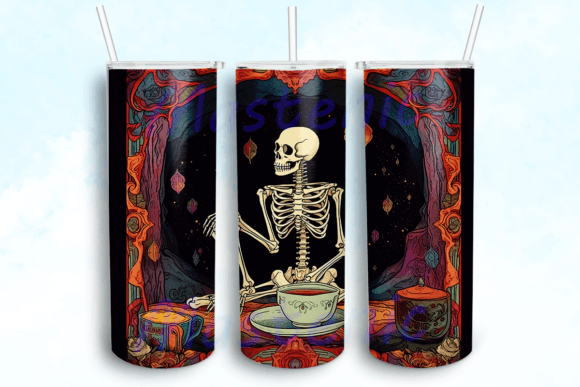
Let’s be real: I opened Skull with Tea Sublimation Design PNG expecting something playful—but not quite this balanced. It’s got that cheeky, slightly irreverent charm—skull meets teacup, steam curling like a question mark—that lands perfectly between “I’m a tea nerd who also owns a leather jacket” and “Yes, I do yoga *and* own a vintage skull ring.” As an embroidery designer who’s stitched everything from baby onesies to boutique aprons, my first instinct wasn’t to admire the art—it was to ask: How will this hold up under needle and thread?
I tested it on a custom embroidered canvas tote bag for a local café pop-up—a project where branding, wearability, and visual clarity all matter. The design sat front-and-center, 8.5 inches wide, stitched in matte black rayon on natural unbleached cotton. Right away, the layout worked: the skull’s eye socket doubles as the teacup’s handle; the saucer forms the lower jawline. It’s clever, but more importantly, it’s embroider-able. No micro-details that vanish at 7x7 hoop scale. No fragile stems or hair-thin outlines begging for satin-stitch collapse.
This isn’t a dense fill-stitch monster—it’s built for readability. The tapered PNG file (9.3 x 8.2) adapts well to curved surfaces like tumblers, yes—but it also translates cleanly to caps and pillow covers when resized thoughtfully. The straight PNG holds crisp edges for flat applications: tea towels, sweatshirt fronts, or embroidered patches meant for denim jackets. As a Graphics asset, it’s clean, centered, and free of watermarks—essential for craft business owners prepping printable mockups or Etsy listings.
Where it shines most is in context-driven projects. Think: a holiday embroidery run for handmade kitchen towels—this design adds wit without overwhelming utility. Or a small shop product line of embroidered aprons for indie bakers (“Brew & Bones” vibes, anyone?). It fits effortlessly into niche gifting too: a personalized gift for a friend who texts you tea memes at 3 a.m. The tone is warm, not edgy; clever, not cryptic. Customers don’t squint—they smile, then click “add to cart.”
That said, use discernment. On thin fabrics like baby onesies or lightweight linen napkins, the skull’s solid areas could feel stiff if over-stabilized—or pucker if under-stabilized. I recommend medium-weight cutaway stabilizer for anything under 200 DPI stitch density. And while the design avoids tiny lettering or nested curves, avoid cramming it into hoops smaller than 5x7 unless you’re willing to simplify key shapes manually. Stretchy fabric? Test first. The teacup’s rim and skull contours rely on clean edge definition—too much give in the knit can blur contrast.
Dark fabric is where Skull with Tea Sublimation Design PNG earns quiet respect. Unlike many sublimation-first graphics, its contrast works in black-and-white mockups—meaning your embroidery file conversion won’t lose legibility on navy sweatshirts or charcoal totes. That’s rare. Most “fun” designs sacrifice silhouette strength for whimsy. This one keeps both.
For Etsy sellers and digital product creators: yes, this works as a starting point for machine embroidery design adaptation—but remember, it’s delivered as PNGs only. You’ll need to digitize it yourself or hire a digitizer. No native .pes, .dst, or .jef files are included. If you’re building an embroidery file library for commercial embroidery clients, factor in that extra step—and confirm licensing terms before bundling it into a paid design pack. The listing says it’s for 20oz skinny tumblers, but nothing prohibits repurposing for apparel or home goods—as long as your end-use aligns with the creator’s terms.
Here’s what I always do before stitching any new design like this:
- Run a test on scrap fabric matching the final project’s weight and stretch
- Check thread color contrast—especially on light backgrounds where white or cream thread might mute the teacup’s steam detail
- Review stitch density visually in your embroidery software; reduce fill % by 5–10% if stitching on textured weaves like terry cloth or bouclé
- Confirm hoop size compatibility—don’t force a 9-inch width into a 4x4 hoop without simplification
- Inspect small details in black-and-white mode: does the skull’s nose bridge still read? Does the teacup’s handle retain shape?
- Compare mockups on both light and dark fabric swatches—some steam lines disappear on black unless you boost stitch count or add outline running stitch
- Use proper stabilizer: tear-away for stable wovens, cutaway for knits, and fusible + tear-away combo for lightweight linens
- Ask: does this support my brand voice? If you sell serene nursery decor, this likely doesn’t fit. But for a craft business rooted in witty, handmade product lines? It’s a quiet standout.
Visually, Skull with Tea Sublimation Design PNG elevates perceived value—not through complexity, but through cohesion. The theme feels intentional, not trend-chasing. That matters when customers scroll past dozens of embroidered tote bag designs on Etsy. It signals craftsmanship, even before the first stitch hits fabric. It builds trust: this isn’t clipart slapped on a template. It’s a considered piece of design assets, scaled and composed with real-world application in mind.
And for handmade presentation? It delivers. Stitched cleanly, it reads as custom—not generic. That’s gold for personalized gifts, craft fair booths, or boutique branding where authenticity sells. It doesn’t shout. It invites a second look. Then a grin. Then a purchase.
If you’re evaluating this for a specific project—say, embroidered baby embroidery (a bold choice, admittedly) or holiday embroidery for a quirky office gift swap—pause and ask: does the mood match the moment? For lighthearted, adult-oriented gifting or small shop merchandise with personality? Absolutely. For formal wedding gifts or infant baptism sets? Probably not. Know your audience. Respect the context.
In short: Skull with Tea Sublimation Design PNG is a quietly versatile Crafts asset—not flashy, not fussy, but thoroughly thoughtful. It’s the kind of design that makes your finished product feel like it was made *for* someone, not just *by* someone. And in today’s handmade economy, that distinction is everything.